

Published Date:
Published By: lrossshared
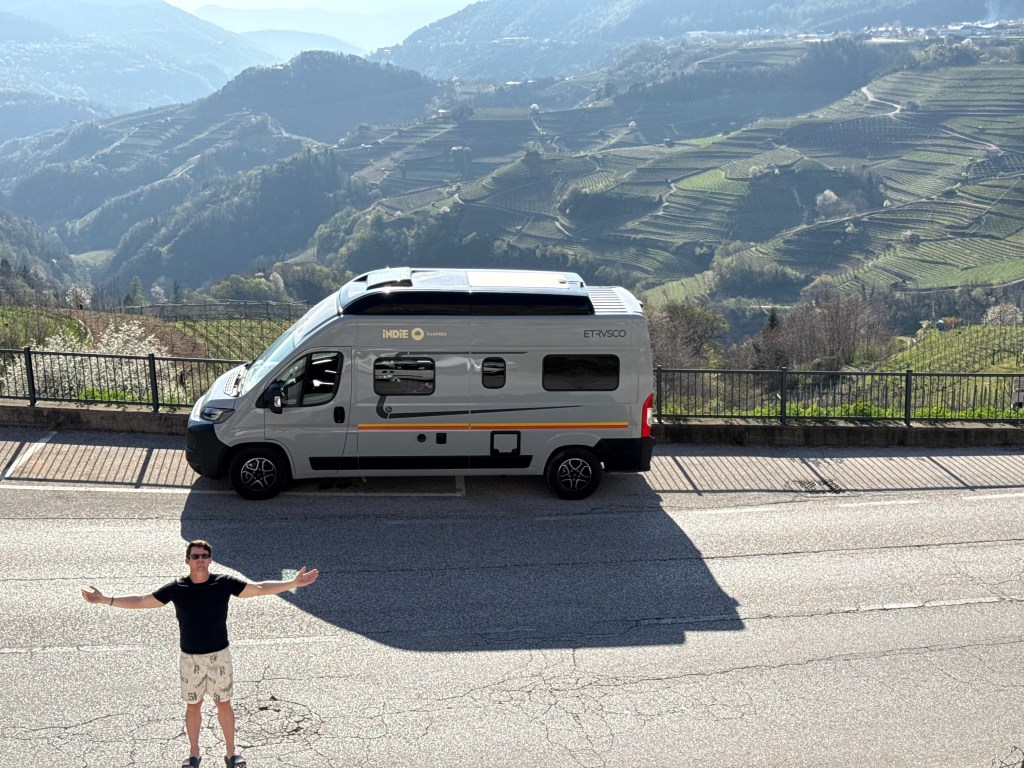
At the beginning, I was just curious to try this kind of travel experience. As a digital nomad, it sounded like it could actually work — I already had flexibility in my schedule, I did not have to be in an office every day, and the idea of having more freedom while traveling was incredibly appealing.
The biggest question for me was always the internet. That was the part that made me hesitate. In 2023, I finally decided to test it for myself and see if this lifestyle could actually work in real life, not just in theory.
Once I did, everything changed.
From the moment I realized that every day could mean a different office with a different view, I was hooked. The freedom to move when I wanted, decide where to go next, stay longer in places that felt right, and discover hidden gems along the way — for me, that was everything.
Of course, it is not perfect. There are challenges, trade-offs, and plenty of small inconveniences that come with living and working from an RV. But honestly, for me, it feels pretty close to perfect. In fact, I have thought seriously about buying one and making this an even bigger part of my lifestyle.
That is why I wanted to share my experience honestly.
I have been living and working from an RV as a digital nomad, and I want to give you the real pros and cons of RV living — not the Instagram version, and not the overly negative version either, but what this lifestyle actually looks like day to day. If you have been thinking about RV life yourself, this post is for you.
You Don’t Have to Live in an RV Forever — That’s the Beauty of It
Here’s something I want to clear up right away: RV living doesn’t have to be a permanent lifestyle choice. You can try it for a month, three months, a summer, a year — or make it your full-time thing. The beauty is that you decide. There’s no contract, no lease to break, no commitment beyond the time you choose.
And the easiest way to do it? Rent. You don’t need to buy a $50K rig to find out if this life is for you. Companies like Indie Campers have made renting a fully equipped motorhome incredibly simple — and I’m not just saying that. I’ve personally been renting with Indie Campers for over 3 years now, and the experience has been consistently great.
What I love about them: they have pickup locations all across Europe and North America, so I can start my trip in one city and drop off the RV in a completely different one — no need to loop back. Every vehicle comes with everything you actually need: a bed, a kitchen, a bathroom, storage space, and the mileage to get where you’re going. And they have a range of sizes depending on your situation — whether you’re traveling solo, with a partner, with friends, or with your whole family.
If you’ve ever been curious about this lifestyle, renting is the move. Test the reality, not the fantasy. And right now, there’s a limited-time opportunity to try it at a discount.
LIMITED TIME OFFER
Code LOREN10 Expires April 22nd!
This is your sign. If you’ve been thinking about trying the RV life, don’t let this deal slip away. Indie Campers has vehicles ready across Europe and North America — pick your dates, choose your rig, and hit the road.
Why RV Living Hits Different for Digital Nomads
Freedom — Like, Real Freedom
I’ve done the hostels, the hotels, the Airbnbs, even the random three-month rentals in cities I barely knew. And honestly, nothing compares to the kind of freedom you get with an RV.
You wake up and decide: stay or go. It’s that simple.
No checkout dates hanging over your head. No reservation confirmations. No pressure to figure out where you’re sleeping next before your current place runs out. Just the freedom to move when you want, and stay when it feels right.
If you pull into a small coastal town or some mountain village and the vibe is good — the people are friendly, the drinks are solid, and the Wi-Fi actually works — you stay. A day, a week, however long you want. And when you’re ready to move on, you just… move on. Your home comes with you.
That kind of flexibility completely changes the way you travel. You stop obsessing over logistics and start actually living.
You See Places You’d Never Find Otherwise
There’s something nobody really tells you: the best places usually aren’t on the first page of Google.
They’re the little towns tucked between the famous destinations. The mountain villages you stumble into by accident because you needed somewhere to park for the night, or simply because they happened to be on the way. The bakery where you stop for a coffee and a pain au chocolat and somehow end up having a real conversation with a local. The kind of places where, for a moment, you feel less like a tourist and more like you’re part of the rhythm of the place.
That’s one of the biggest things I love about RV travel. You don’t just fly over a country and bounce between major cities. You drive through it. You pass through the in-between places. And that gives you a completely different perspective.
No More Hotel Bookings (Seriously)
I really can’t overstate how freeing this is.
No more constantly refreshing Booking.com. No more comparing ten hostels or scrolling through Airbnbs that all start to look exactly the same. No more 3 p.m. check-ins and 11 a.m. checkouts.
Your bed is always your bed. Your kitchen is set up the way you like it. Your workspace is right where you left it.
And this is something people who travel a lot will understand immediately: constantly packing, unpacking, moving, checking in, checking out — it wears you down fast. It looks exciting from the outside, but after a while, it becomes exhausting.
With an RV, that whole cycle disappears. Your stuff stays where it is. You don’t have to keep rebuilding your life every few days.
You just start the engine and go.

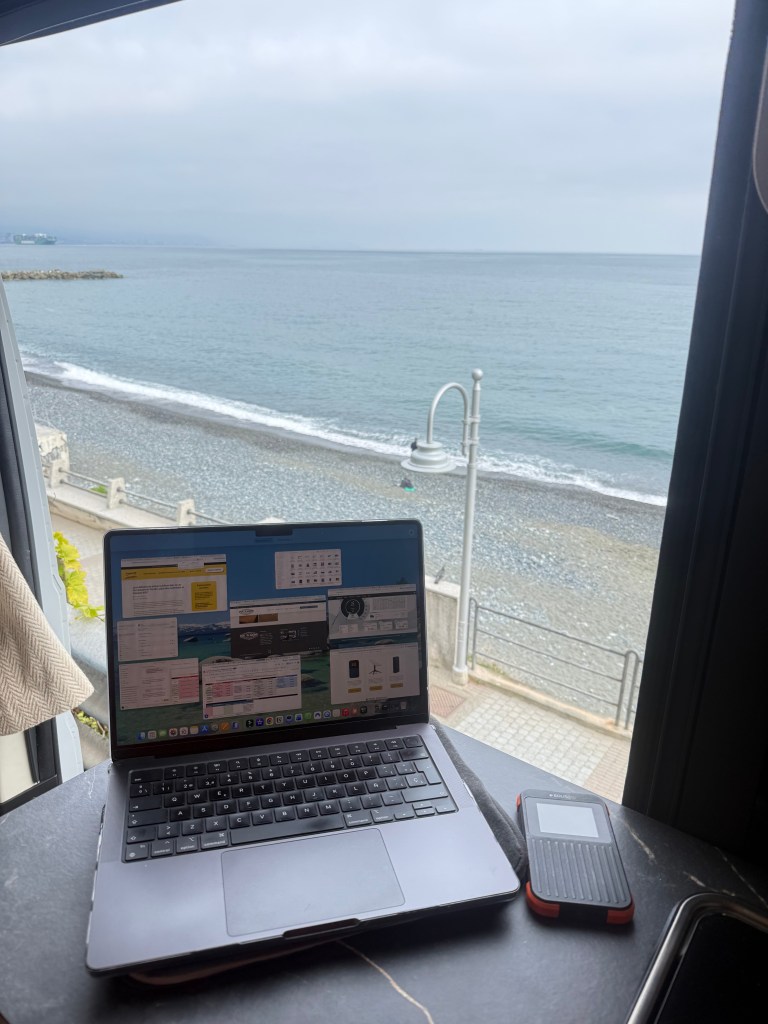
Working Remotely from an RV: Starlink Changed the Game
Let’s be real — none of this works if you can’t get online. And for a long time, that was the biggest barrier to RV life for remote workers. Campground WiFi? Useless for anything beyond checking email. Cellular hotspots? Great in cities, dead in the countryside.
Then Starlink showed up and changed everything.
✈️ From My Experience: Starlink actually works better in remote areas. I’ve had my fastest, most reliable connections parked in the middle of nowhere — national forests, rural farmland, mountain passes. The fewer people around competing for bandwidth, the better it performs. For a digital nomad in an RV, that’s the perfect match.
With a Starlink dish on your roof and a decent cellular backup plan, you can take video calls from a lakeside campsite, upload client deliverables from a forest clearing, and keep your workflow running from practically anywhere. It’s the piece that makes this lifestyle sustainable long-term — not just a vacation, but a real way of working.
My Personal Connectivity Setup: What I Actually Use on the Road
I get asked about my exact setup all the time, so let me break it down. I use two devices that together give me reliable internet no matter where I park — and they complement each other perfectly.
📡 Starlink Mini — My Primary Internet
This is the backbone of my whole remote work setup. The Starlink Mini dish is compact enough to mount on the roof of my RV, and it delivers speeds that honestly rival most home internet connections. My routine is simple: when I park, I look for a spot where the dish has a clear line of sight to the north — that’s the direction it needs to face for the best signal. I mount it on the highest point of the caravan, and within minutes I’m online with fast, stable internet. It works in the middle of the countryside, in mountain passes, on beaches — places where cell signal doesn’t even exist. For a digital nomad working from an RV, this is the single most important piece of gear you’ll own.
📱 Solis 5G Hotspot — My Backup & Travel Companion
The Solis 5G hotspot is my secret weapon for staying connected on the move. It works like a portable SIM card — no contracts, no local SIM swapping — just turn it on and you have internet in 140+ countries. I use it as my backup when Starlink isn’t set up yet (like during driving days or quick stops), but honestly it’s become essential for something else too: my girlfriend uses it while I’m driving. She connects to the Solis, hops on her laptop, and works from the passenger seat while we’re cruising down the highway. It’s a game-changer for couples who both work remotely. The signal is reliable, it connects up to 16 devices, and it even comes with some free lifetime data to get you started.
💡 How they work together: When we’re parked, I set up the Starlink dish facing north on the roof of the caravan — that’s the sweet spot for the best connection. We both work off Starlink for the day. When we’re on the move, my girlfriend switches to the Solis hotspot and keeps working from the passenger seat while I drive. Between the two devices, we’re never offline. That combination of stationary power (Starlink) and mobile flexibility (Solis) is what makes this lifestyle genuinely sustainable for remote work.
Only a few days left! Use code LOREN10 on Indie Campers before April 22nd and save on your first RV adventure.
Reserve Now →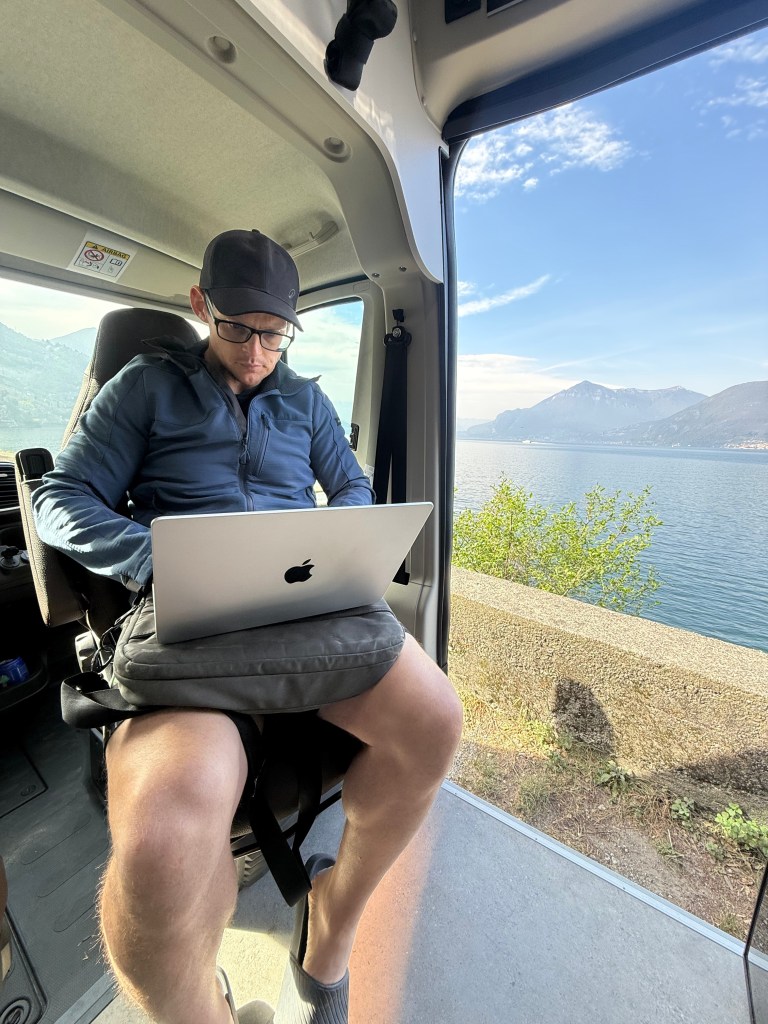
Cross Borders Without Booking Flights
This is one of my favorite parts. In Europe, you can drive from Spain to France to Italy to Slovenia — all without a single flight, without any luggage limits, without losing a day to airports. You just cross the border and keep going. Your home, your stuff, your whole setup moves with you.
Same thing in North America. You can road-trip from Canada through the U.S. into Mexico, and every stretch feels like a completely different world.
⚠️ Pro Tip: A lot of people don’t realize this: with some RV rental companies, you can pick up your vehicle in one country and drop it off in another. That means you can do a one-way trip across an entire continent without looping back. It opens up a completely different way of traveling.

Map of the route I took during this 15-day trip
The Pros and Cons of RV Living: The Honest Breakdown
Alright, let’s lay it all out. I love this lifestyle, but I respect it enough to tell you the whole truth. Here’s what’s great and what’s hard.
✅ The Pros
- Total freedom over your schedule and route
- No hotel bookings, no check-ins, no checkout stress
- Your home travels with you: kitchen, bed, workspace — everything
- You discover hidden gems most travelers never get to see
- Reliable remote work with Starlink or a hotspot, especially in places off the grid
- No more constant packing and unpacking — your things stay where they belong
- Cross-border travel without flights or luggage limits
- A slower, more intentional way to experience the world
⚠️ The Cons
- Managing power takes planning, whether that means batteries or generators
- Water is limited, so showers are shorter and daily use has to be more intentional
- Smaller space means less storage and a tighter day-to-day setup
- Maintenance is real: tires, waste tanks, repairs, and general upkeep all matter, especially the longer you stay on the road
- If you choose campgrounds instead of simple parking areas, you’ll need to pay nightly fees, and costs can vary a lot
- It can feel isolating if you do not intentionally build community along the way
- It requires a mindset shift — and it is definitely not for everyone
Only a few days left! Use code LOREN10 on Indie Campers before April 22nd and save on your first RV adventure.
Reserve Now →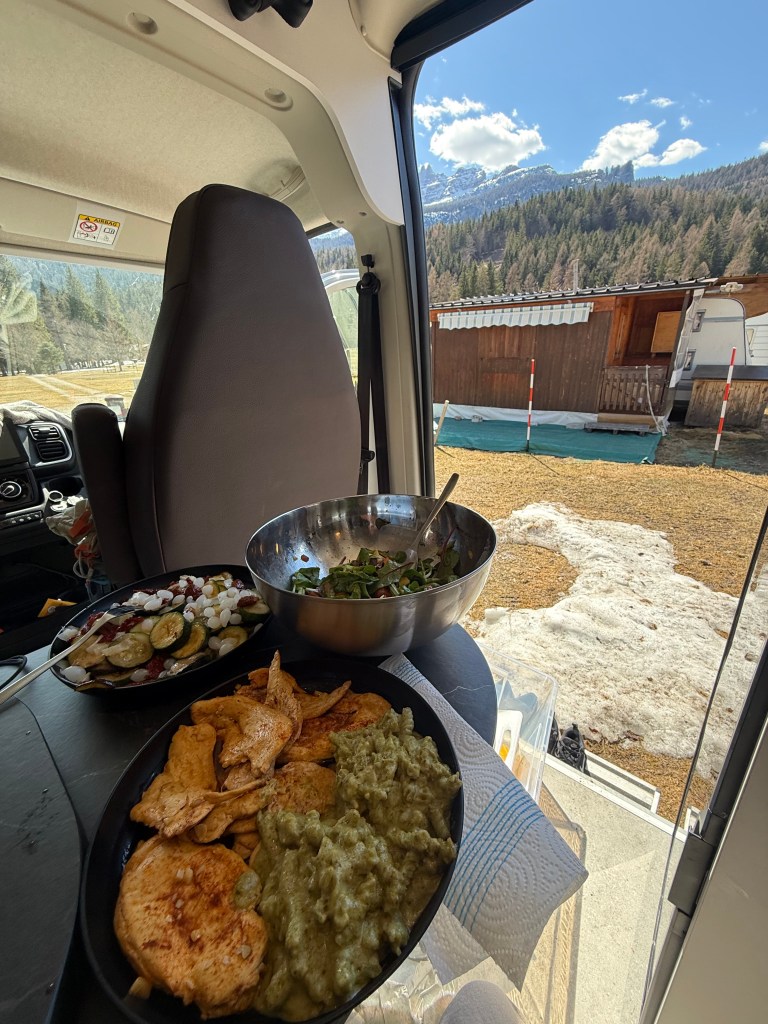

The Practical Stuff: What Daily Life Actually Looks Like
People always want to know about the unglamorous parts. Fair enough. Here’s a quick breakdown of the daily realities.
| Daily Need | How It Works in an RV | Difficulty Level |
|---|---|---|
| Electricity | Solar panels and a battery bank usually cover off-grid use. At campgrounds, you can plug into shore power, and some setups also have a generator as backup. | Moderate: there is a learning curve |
| Showers | You can use the onboard shower for quick showers, or use campground facilities and truck stops. You adjust to it pretty quickly. | Easy once adjusted |
| Bathroom | Most RVs do have a toilet option, but personally, we usually avoid using it to prevent bad smells inside the RV. Because of that, it often means planning ahead and looking for places where you can use a bathroom instead. | Moderate: not always easy to find |
| Cooking | Most RVs come with a stove, fridge, and sink, so you can cook simple homemade meals without depending on takeout all the time. | Easy — one of the best parts |
| Internet | My two essentials during the trip are always Starlink and Solis. That combination has worked best for me and gives me the most reliable connection while traveling. | Easy with the right setup |
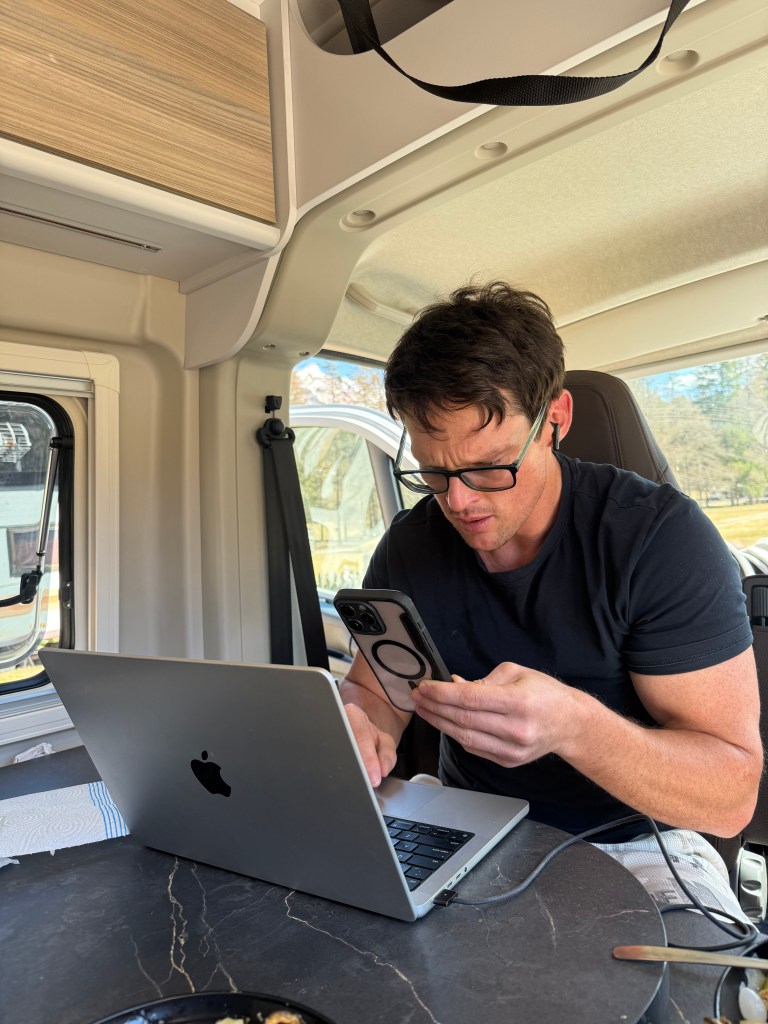
| Workspace | There are workspace options inside the RV, but you can also use the outdoor table and chairs as a second setup. That gives you the flexibility to work outside the RV as well. | Easy |
| Laundry | Usually it means using laundromats at campgrounds or in nearby towns and planning to do it about once a week. | Easy: just plan ahead |

A photo of my girlfriend working from bed with an incredible view of the Mediterranean.
How Much Does RV Living Actually Cost? (Approximate Monthly Budget)
I’m not going to tell you RV life is automatically cheaper than renting an apartment. Sometimes it is. Often it isn’t — especially if you’re moving frequently or staying at full-hookup resorts. Here’s an honest monthly budget breakdown based on my experience in 2026. Your numbers will vary depending on travel pace and lifestyle choices.
| Expense Category | Budget Range (Monthly) | Notes |
|---|---|---|
| Camping / Parking Fees | $0 – $1,200 | Free if you use public land or simple overnight parking when allowed. Paid campgrounds and RV parks can range from around $30 to $60+ per night depending on the location and amenities. |
| Internet (Starlink + Solis) | $150 – $300 | My two main essentials are Starlink and Solis. This setup gives me the most reliable connection while traveling, especially when I need to work consistently on the road. |
| Fuel | $300 – $800 | This depends a lot on how often you move. Slower travel usually means spending much less on fuel. |
| Propane / Dump Fees / Small Essentials | $50 – $150 | These are the smaller recurring costs that can add up over time, including propane refills, dump station fees, and a few day-to-day necessities. |
| Groceries | $300 – $700 | Cooking in the RV can save a lot compared to eating out all the time. |
| Restaurants / Eating Out | $100 – $500 | This depends completely on your lifestyle. You can keep this low, or spend much more if you like going out often. |
| RV Rental (if renting) | $1,500 – $3,500+ | This varies depending on the type of vehicle, rental company, destination, and season. |
⚠️ Important: Your monthly budget can vary a lot depending on how many days you stay in each place, the destinations you visit, how often you move, and the type of places where you choose to park or camp. Traveling more slowly, staying longer in one area, and using free or low-cost parking can reduce expenses significantly. On the other hand, moving often, visiting more expensive destinations, or staying in paid campgrounds and RV parks will raise your costs. It’s best to start with a conservative budget for your first couple of months and then adjust based on your travel style and daily needs.
Ready to Test the RV Life?
Indie Campers makes it easy to rent a well-equipped motorhome across Europe and North America. It’s the simplest way to see if RV living is right for you — no commitment, just adventure.
Use code: LOREN10
for a discount on your first Indie Campers booking
Real Talk: What Can Go Wrong When Renting an RV (My Experience)
One thing I would personally recommend if you are renting an RV — use AI or any tool you have to really understand the rental terms before you pick up the vehicle. It might sound simple, but contracts are not always easy to understand, especially when you are traveling.
Overall, I have had good experiences renting with Indie Campers. In the past, whenever I had a question or small issue, their team responded quickly and everything was handled smoothly.
But this last trip was different.
One day before my check-in, I was driving towards Paris with about 200 km left. I decided to stop for a quick break to eat. When I got back to the van and tried to start driving again, I realized the tire was completely flat.
To this day, I still do not understand how it happened — I had been driving on the highway the entire time.
When I reached out for help, I ended up speaking with three different people, and all of them told me the same thing: it was not their responsibility. They could send assistance, but it would cost me more than €600.
What made it worse was that the campervan did not even have a spare tire.
In that moment, as a customer, you feel completely stuck — in the middle of nowhere, without real support, and without the tools to fix the situation yourself.
In the end, I had to pay for a tow truck, replace the tire, and wait more than 24 hours before I could continue my trip.
Now, this does not mean you should not rent an RV. I still believe it is one of the best ways to travel and experience the world.
But what I would say is this: read your contract carefully. Make sure you understand what is covered and what is not. As travelers, we do not always have the tools or knowledge to handle these situations on our own, so it is important to know what kind of support you will actually get if something goes wrong.

Final Thoughts
The pros and cons of RV living are real, and they deserve honest conversation. This lifestyle isn’t a vacation — it’s a deliberate choice to trade some comfort and convenience for freedom, flexibility, and a deeper connection to the places you visit.
For me, it’s been one of the most rewarding decisions I’ve made. Not because every day is perfect, but because even the imperfect days happen on my terms, in places I chose, with a life I designed. If that sounds like something you’ve been craving — even a little — I think it’s worth exploring. Start with a rental. See how it feels. And if you need a nudge, come say hi on the About Me page. This community is full of people at every stage of the journey, and you don’t have to figure it out alone.
Frequently Asked Questions About RV Living
Is RV living actually cheaper than renting an apartment?
It depends entirely on your travel style. If you boondock on free public land, cook your own meals, and move slowly, you can absolutely spend less than a typical apartment rent. But if you stay at full-hookup RV resorts, move frequently, and eat out a lot, costs can add up quickly. A realistic budget for a solo person or couple ranges from $900 to $2,500+/month before food. The biggest variable is campsite costs and fuel — slow travel on free or cheap sites is the key to keeping it affordable. This is general information, not financial advice.
Can I really work a full-time remote job from an RV?
Yes — and thousands of people do it in 2026. The key requirements are a reliable internet setup (Starlink plus a cellular backup is the gold standard), a dedicated workspace inside your rig, and a work schedule that accommodates your movement. Jobs that are async-friendly or output-focused are the easiest fit. If your role demands eight hours of back-to-back video calls from a fixed quiet location, you’ll need to plan more carefully — but it’s still doable with the right setup.
Do I need Starlink to work from an RV?
Starlink is one of the most reliable internet options for working from an RV, especially if you spend time in rural or remote areas. In my case, my two essentials are always Starlink and Solis. That combination gives me the flexibility to work from a wide range of places while traveling. If you mostly stay in towns or cities with strong coverage, you may be fine without Starlink, but if you want more freedom to work from quieter and more remote spots, having both Starlink and Solis makes a huge difference.
What are the biggest challenges of living in an RV?
The top challenges are: managing power and water (especially off-grid), dealing with limited space and storage, vehicle maintenance and unexpected repairs, and the mental adjustment to a smaller, more mobile lifestyle. Weather extremes — both heat and cold — can also be tough depending on your RV’s insulation. And honestly, if you move too fast, burnout is real. The people who sustain this lifestyle long-term tend to stay 1–2 weeks minimum per location and protect their non-work time deliberately.
Can I travel to multiple countries in an RV?
Absolutely. In Europe, you can drive across multiple countries seamlessly — Spain to France to Italy to Slovenia, all without flights. In North America, you can road-trip from Canada through the U.S. into Mexico. Some RV rental companies even let you pick up in one country and drop off in another, so you don’t have to loop back to where you started. It’s one of the most exciting aspects of RV travel.
Should I buy or rent an RV to start?
Rent first — always. Spend at least a week or two actually living in an RV before making any buying decisions. Cook in it, work in it, drive it, sleep in it, deal with the water tank. You’ll know within a few days if this lifestyle clicks for you. Companies like Indie Campers make it easy to rent a well-equipped motorhome across Europe and North America. Use code LOREN10 for a discount on your first booking if you want to give it a try.
How do I handle electricity and showers while living in an RV?
For electricity, it really depends on your setup and where you’re staying. Some places offer hookups, and in other situations you simply have to be more aware of your power use and plan around it. Showers are similar — most RVs have a small onboard shower, but water is limited, so you quickly learn to be efficient. Campground facilities and truck stop showers can also be great alternatives. It sounds like a big adjustment at first, but most people get used to it pretty quickly.
LIMITED TIME OFFER
Code LOREN10 Expires April 22nd!
This is your sign. If you’ve been thinking about trying the RV life, don’t let this deal slip away. Indie Campers has vehicles ready across Europe and North America — pick your dates, choose your rig, and hit the road.