

Being a digital nomad in Madagascar might be the most adventurous rite of passage our community has — and after weeks of real WiFi speed tests, power cuts, and long red-dirt drives between baobabs and lemurs, here’s my honest digital nomad Madagascar guide: the real costs, visas, the best bases, and exactly where to stay and work in 2026. Fair warning up front — this is not a polished, coworking-on-every-corner destination. It’s wild, slow, and unforgettable.
Published Date:
Published By:

Digital Nomad Madagascar FAQs
Is Madagascar a good destination for digital nomads?
Honestly, only for the right person. Madagascar is one of the most beautiful, wild and affordable places you can work from — baobabs, lemurs, empty beaches and a culture unlike anywhere else — but it is not a plug-and-play nomad hub. There’s little nomad community, WiFi is inconsistent, power cuts are common, and getting around is slow. It’s a great fit for experienced, flexible nomads who don’t live on video calls and want adventure over convenience. If you need reliable internet all day, look elsewhere.
What are the best places to base yourself in Madagascar?
Antananarivo (Tana) has the best infrastructure and coworking and is the arrival and logistics hub, though it’s chaotic. Antsirabe is a calmer, walkable highland town. Nosy Be is the island-lifestyle pick (pricier and touristy). Fort Dauphin and Morondava are for nature and surf but need domestic flights. Most people move around in blocks of days rather than settling in one place for months.
Is the internet good enough to work remotely in Madagascar?
It’s inconsistent. In my tests the capital hit 180+ Mbps at good hotels and some cafés were excellent, but plenty of places sat under 10 Mbps or dropped during power cuts. Don’t rely on hotel WiFi alone: carry a local SIM (Yas or Orange) with mobile data, and if your income depends on calls, seriously consider a Starlink Mini — it gave me the most reliable connection by far.
Do I need a visa for Madagascar?
Yes. There’s no digital nomad visa, so almost everyone uses a short-stay tourist visa, available online via the official eVisa portal (evisamada.gov.mg) or on arrival at Ivato airport. Fees run about $35 for up to 15 days, $41 for 30 days and $47 for 60 days, and you can extend to a maximum total stay of 90 days in-country.
Is Madagascar safe for travellers and remote workers?
With sensible precautions, yes. Petty crime such as pickpocketing and bag-snatching is the main day-to-day risk, especially in Antananarivo’s crowded areas. The bigger risks are travelling by road at night and on remote highways — avoid both, use hotel or pre-booked taxis, and don’t flash phones or cash. The US currently lists Madagascar at “Level 2 – Exercise Increased Caution.”
How much does it cost to live in Madagascar as a nomad?
It’s cheap by Western standards — Numbeo puts costs around 65% below the US. A single person’s monthly expenses land near $400 excluding rent, meals are often $2–$10, and a comfortable all-in budget runs roughly $800–$1,500 a month. The real money goes on transport (private drivers, 4x4s, domestic flights) and backups for power and internet — not rent or food.
Visitor / Working Visas For Madagascar
The visa information below may not be up to date. This should not be used as official visa advice. Always refer to your nearest Madagascar embassy or the official Madagascar eVisa portal (evisamada.gov.mg) for the latest information. At Digital Nomad Lifestyle we believe in following the laws and regulations of every country. In Government We Trust — Digital Nomad Lifestyle
Want to learn more about digital nomad visas around the world? Click here: Digital Nomad Visa Guide: Countries Offering Long-Term Stay Options 2025
Average Tourist Visa Length
Madagascar doesn’t have a digital nomad visa, so almost everyone travels on a short-stay tourist visa. You can apply in advance through the official eVisa portal (evisamada.gov.mg) or buy one on arrival at Antananarivo’s Ivato airport, payable in USD, EUR or Ariary. Fee tiers run roughly $35 for 1–15 days, $41 for 16–30 days, and $47 for 31–60 days. Stays up to 15 days are technically visa-free but still carry a small administration fee on arrival, and you’ll be asked to show onward tickets. Your passport should be valid at least six months beyond arrival, with two blank pages.
Digital Nomad Visa Option
There is no dedicated digital-nomad or remote-work visa for Madagascar as of 2026. A few third-party websites claim one exists, but it doesn’t appear on the official government portal, so treat those claims with caution. In practice, remote workers simply travel on the tourist visa. If you need to stay longer than the tourist visa allows, you’ll need to apply in advance to a Madagascar embassy for a long-stay visa.
Long-Term Visa Options for Remote Workers
The eVisa maxes out at 60 days. If you want longer, buy a 30- or 60-day tourist visa and extend it in-country at the Immigration office in Antananarivo, up to a maximum total stay of 90 days — that’s the effective ceiling for tourists. Overstaying is taken seriously and can mean detention or deportation, so plan your exit before day 90. For anything beyond three months (work, residence or volunteering), you’ll need the appropriate long-stay or immigrant visa arranged through a Madagascar embassy before you travel. Always confirm the latest rules on the official eVisa portal, since fees and durations change.
Cost Of Living / Traveling Through Madagascar
Before you decide how long to stay in Madagascar, it helps to understand what things actually cost. Madagascar is genuinely inexpensive by Western standards — Numbeo puts the overall cost of living around 65% below the US, and rent about 80% lower. A single person’s monthly costs land near $400 excluding rent, and a family of four around $1,435. For most digital nomads, a comfortable monthly budget runs roughly $800–$1,500 including a good hotel or apartment; you can go lower in the highlands and higher on islands like Nosy Be, where tourist pricing kicks in. The bigger expenses here aren’t rent or food — they’re transport (private drivers, 4x4s and domestic flights) plus backups for power and internet. If you want a complete breakdown of costs and smart budgeting strategies, read our Digital Nomad Budget Guide.
(Single Adult)
(city center)
(One Way)
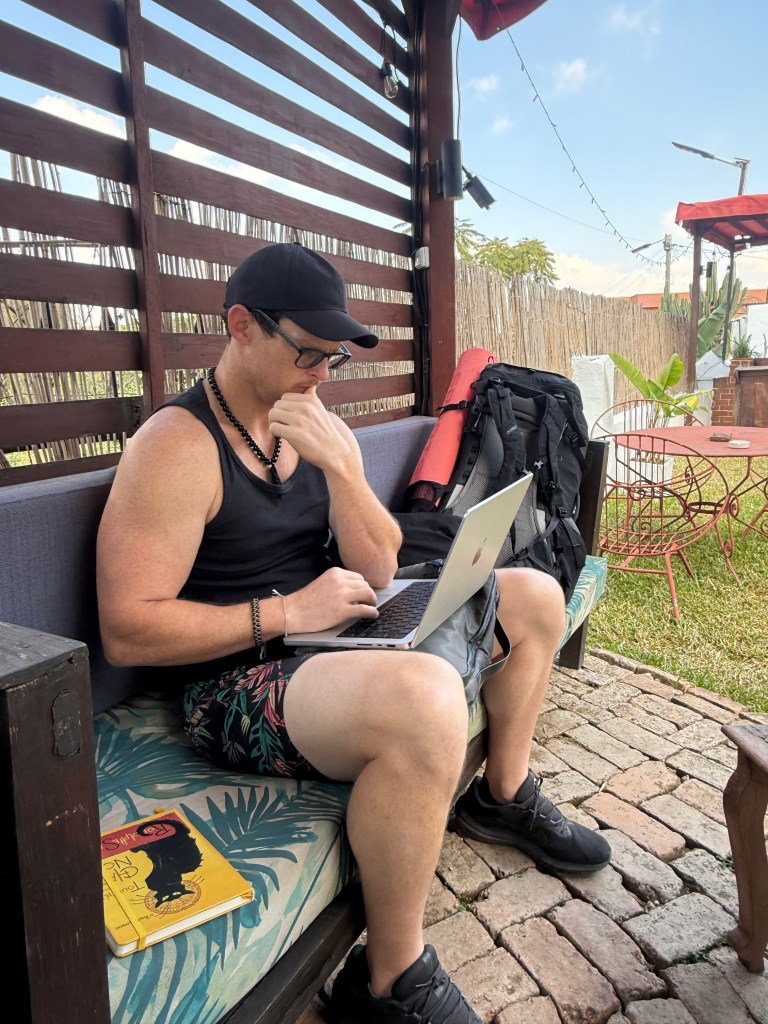
Worked from a hostel in Madagascar.
Digital Nomad Madagascar Wifi Speed Tests
Internet is the make-or-break factor for working remotely in Madagascar — and it’s genuinely inconsistent. Some places surprised me (La Varangue in Tana hit 188 Mbps, and Tsimoka café in Antsirabe ran on Starlink at 219 Mbps), while others crawled under 10 Mbps or dropped entirely during a power cut. The single most important thing here isn’t the WiFi number — it’s having a backup. Confirm the connection before any long stay, carry a local SIM (Yas or Orange) with mobile data, and if your income depends on calls, seriously consider bringing your own — or go one step further with a travel hotspot or the Starlink Mini. For serious video calls, uploads and client work, don’t rely on venue WiFi alone: the strongest, most reliable results I got came from a Starlink Mini (200+ Mbps even in remote towns), and in the capital La Varangue and Villa Mahefa were solid. Cafés are hit-or-miss — Tsimoka in Antsirabe was excellent, but many spots barely handle a call. And remember, a good speed test means nothing during a power cut, which is why keeping mobile data as a backup is non-negotiable here.
Read my guide to getting fast wifi anywhere in the world here
Real talk: finding good WiFi in Madagascar is genuinely hit-or-miss. Even in hotels it might work fine in reception and then basically die the second you’re in your room. What I found is that a lot of places actually run their own Starlink just to have internet at all. I tried my Solis hotspot too, but honestly it didn’t work for me — so I ended up always hunting for spots with open sky where I could set up a Starlink. And even though it dropped out now and then, Starlink was my main lifeline for solid WiFi and enough power to hold a video call.
Averages across all 25 tests (June 2026), including my own Starlink Mini. Hotel & café WiFi alone runs lower — treat this as a range, not a guarantee.
| City | Place | Type | ↓ Mbps | ↑ Mbps | Latency | Notes |
|---|---|---|---|---|---|---|
| Antananarivo | Restaurant La Varangue — from room | Hotel | 188 | 158 | 7 ms | Yas |
| Antananarivo | Le Café | Café | 1.6 | 1.6 | 380 ms | Email/browsing only |
| Antsirabe | Tsimoka Coffee Shop | Café | 219 | 44.5 | 89 ms | Runs on Starlink |
| Antsirabe | Eco Lodge Les Chambres du Voyageur | Hotel | 14.4 | 1 | 30 ms | Orange |
| Ambalavao | Camp Catta — from lobby | Hotel | 278 | 48 | 89 ms | Reception only |
Want the full data? This is just a 5-spot preview — I tested WiFi at every hotel, café and town on this trip. Drop your email and I’ll send you the complete speed-test sheet for every place in Madagascar.
Get a sneak peek at WiFi speeds you won’t find anywhere else
We’ll email our real speed notes from places we’ve actually stayed.
A Map of Where to Stay & Work in Madagascar
Choosing where to base yourself in Madagascar completely changes your experience. Antananarivo is the practical hub for arrivals, flights and coworking; Antsirabe is a calm highland town; the RN7 south (Fianarantsoa, Ambalavao) is the classic overland route; and the coast — Morondava for the baobabs, Nosy Be and Fort Dauphin for beaches and surf — rewards those willing to fly or drive. If you’re still figuring out where to stay, check out our How to Find Digital Nomad Accommodation | Expert Tips (2025) for practical advice on choosing the best place for your needs.
Use the colored points to explore cafés, stays and work spots across Madagascar.
Where I Stayed in Madagascar
Hotel☆
Hotel☆
Hotel☆
Hotel☆
Hotel☆
Hotel☆
Places To Stay in Madagascar – Honorable Mentions
These are places I passed through on the RN7 heading south — comfortable enough stopovers worth knowing about, even if they didn’t make my main list. WiFi figures below are my own real speed tests.
Hotel☆
Hotel☆
Hotel☆
Hotel☆
Hotel☆
🏡 A note on booking in Madagascar: There aren’t really established coliving spaces here the way there are in Bali or Lisbon, so I mostly booked hotels and guesthouses through Booking.com — and it’s worth messaging places directly to confirm the WiFi and whether they have a generator for power cuts. I didn’t personally try it, but if you’d prefer a coliving-style stay, there are a handful of listings worth a look on Coliving.com.
My Favorite Places To Work From in Madagascar
Café☆
A central café in Tana where one side is a small, free museum that’s easy to pop into. Plenty of locals and a few travellers, tables both outdoors and inside, and a pleasant spot to settle in. One catch: when you buy a drink you get a WiFi code that only lasts about two hours, so plan to reorder.
⬇ 1.6 Mbps⬆ 1.6 Mbps⏱ 380ms
Café☆
A very central, cozy spot in Antsirabe — and the one place we found in town with genuinely strong WiFi. Warm space, friendly staff, good coffee. This was my go-to for actually getting work done.
⬇ 219 Mbps⬆ 44.5 Mbps⏱ 89ms
Café☆
Even if you’re not staying here, the restaurant area is a comfortable place to set up and work in Morondava. The signal is solid in the restaurant; it varies a bit depending on where you sit.
⬇ 44 Mbps⬆ 43 Mbps⏱ 80ms
Health & Safety in Madagascar
Madagascar is generally welcoming, and the everyday risk for travellers is low-level petty crime rather than anything dramatic — but there are real risks worth taking seriously. Pickpocketing and bag-snatching happen in crowded parts of Antananarivo, so keep your phone and cash out of sight and use a bag that closes securely. The bigger danger is the road: travelling between towns after dark is genuinely risky (armed robberies do happen on rural highways at night), so plan to arrive before sunset and use hotel or pre-booked taxis in the cities. The US currently lists Madagascar at Level 2, “Exercise Increased Caution.” If you want a deeper breakdown of how to reduce risk while traveling, check out this guide on Reducing Risk While Nomading (Digital Nomad Safety Guide 2026)
On a personal note, though, I spent a lot of hours on Madagascar’s roads and — thankfully — nothing ever went wrong. I even drove the RN4, one of the routes flagged as riskier, and honestly I think driving in daylight makes all the difference. Out there, breakdowns are just part of the deal: local buses conk out constantly and end up stranded in the middle of the highway. I picked a few people up and drove them all the way to Morondava, and it cut both ways — having company in the truck gave me a little peace of mind too, and it felt like paying back all the times a stranger stopped for me when I was young and hitchhiking. You’ll also pass plenty of police checkpoints along the way. One very practical tip from experience: download maps.me and use it alongside Google Maps. Google Maps loves to send you on “shortcuts” that turn out to be long, potholed dirt tracks — one of those detours even had a random “toll” I paid thinking it was a park entrance (it was… nothing — I just paid for the privilege, ha), and another dropped us at a little river we had to ford, right where the women of a village were bathing. Comparing the two apps saved us more than once. So no, none of this means you should drop your guard — take the safety advice above seriously — but with daytime driving, a backup map and a bit of common sense, our road trips genuinely felt fine.
🛡️ Safety Ranking
Global Peace Index: Madagascar ranks ~57 out of 163 (relatively peaceful)
Crime Index: ~62 — Moderate (higher in Antananarivo)
Common Risks: Pickpocketing & bag-snatching, night road travel, rough roads, cyclones (Nov–Apr)
Health Risks: Malaria & mosquito-borne illness (repellent + antimalarials), traveller’s diarrhoea from food/water, rabies (avoid stray dogs)
Areas to Avoid at Night: Any rural highway after dark, quiet streets in Antananarivo, isolated areas
Solo Traveler Safety: Fair — little nomad infrastructure, so be self-reliant; use hotel taxis and avoid night travel
💡 Nomad Tip: Use hotel or pre-booked taxis rather than flagging cars in the street, and never travel between towns by road after dark. Carry a power bank and a backup SIM — power and mobile network often drop together.
🍽️ Food & Water Safety
Tap Water: Do NOT drink — tap water is unsafe across Madagascar, even in cities. Stick to sealed bottled water, or boil, filter or purify, and avoid ice unless it’s made from purified water
Local Canteens & Street Food: Cheap and tasty — try masikita (grilled zebu skewers) and mofo gasy; pick busy stalls cooking fresh in front of you
Raw Salads & Unpeeled Fruit: Be cautious at very local or low-turnover spots
Ice in Drinks: Skip it unless you know it’s made from purified water
Traveller’s Diarrhoea: Common — hydrate aggressively, use oral rehydration salts, and seek medical help for fever, blood in stool, severe dehydration, or symptoms lasting more than a few days
Brushing Teeth: Use bottled or filtered water if your accommodation’s water quality is uncertain
Best Food Areas: Antananarivo has the widest range; look for romazava (the national zebu & greens stew), ravitoto (pork with cassava leaves), grilled zebu, and fresh seafood on the coast — French-influenced restaurants are common in bigger towns
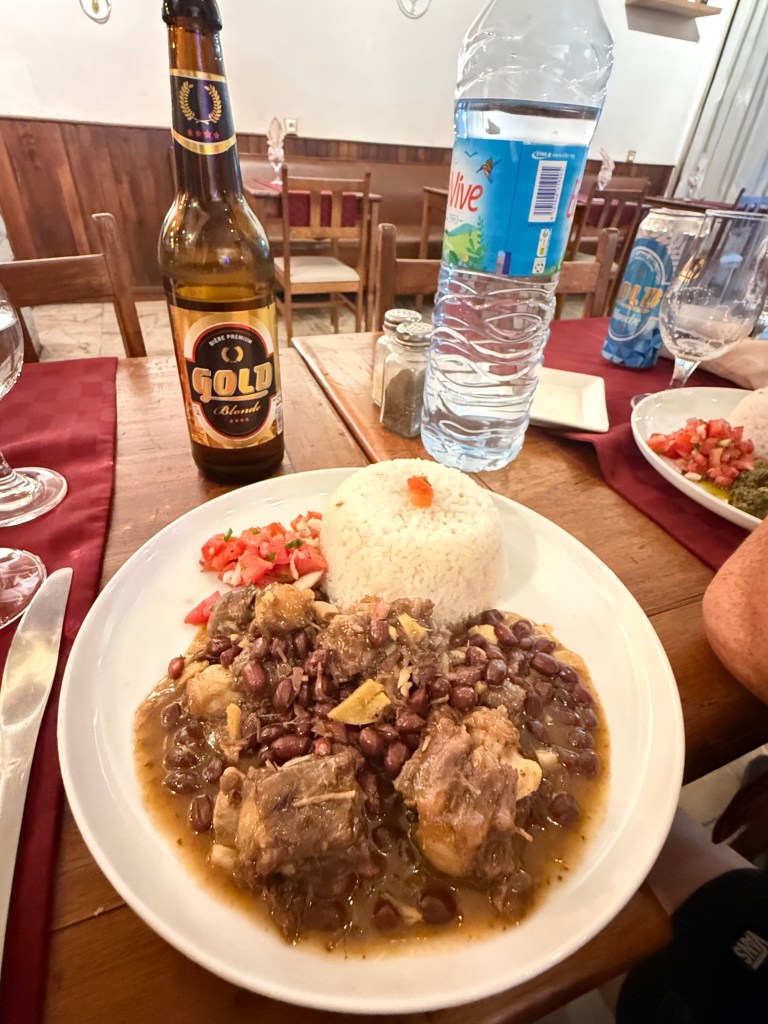
One of our classic meals in Madagascar: rice, beans, and zebu. Honestly, we ate zebu almost every day — it’s one of the most common animals in the country.
🏥 Healthcare System
Healthcare Quality: Limited — private clinics in Antananarivo handle routine care, but facilities are basic elsewhere; serious cases are evacuated abroad, usually to Réunion, Mauritius or Johannesburg
Hospital Recommendation: Polyclinique d’Ilafy and Espace Médical (Antananarivo)
Pharmacy Access: Available in Tana and larger towns, but stock is unreliable — bring your own prescription meds in original packaging
Emergency Number: 117 (mobile) / 17 (landline) for an ambulance
Travel Insurance: Essential — it must cover medical evacuation and repatriation, not just local treatment
Avg. Doctor Visit Cost: $15–$50 USD (private clinic)
🌍 Travel Insurance for Nomads
Don’t travel without proper health coverage. We recommend Genki — built specifically for digital nomads and long-term travelers with flexible monthly plans.
Taking care of your health as a digital nomad goes beyond food and water safety. Mental well-being is just as important when living abroad, especially if you’re constantly moving or working remotely. If you’re struggling with isolation or want to stay balanced while traveling, check out this guide on: Beating Loneliness: 18 Essential Mental Health Tips for Digital Nomads.

No medical emergencies in Madagascar, luckily. Just me risking it all for smoother skin with a local face mask.
Transportation in Madagascar
Transportation is one of the biggest realities of life in Madagascar — and one of the main reasons the island suits slow, flexible nomads rather than people hopping between meetings. It looks small on a map, but it isn’t: roads are often rough and winding, so a 200 km trip can easily take six hours or more, and some drives stretch to a full day behind the wheel. There’s no traveller-friendly train network, night driving is genuinely risky, and domestic flights (handy as they are) are prone to delays. Here are the best options ranked for digital nomads:
Personally, the way that works for me is renting a car and building my own route. If I stumble on somewhere I love, I want to be able to stop and stay longer than planned — having a guide with everything scheduled just isn’t my style, so renting a car ended up being one of the best decisions of the trip. One tip: book it in advance. Every time I tried to rent same-day, availability was gone. And of course, what’s on offer depends on the city you’re in — here are the main ways to get around:
💡 Pro Tip: Never travel between towns by road after dark, and use a recommended driver for long routes — nighttime road robberies and accidents are among the most common serious risks for travellers in Madagascar. Area notes: in Antananarivo, use taxis or a hired driver — the centre is walkable in patches, but hills and traffic make it tiring; Antsirabe is the most walkable town and famous for its pousse-pousse (cycle-rickshaws); on the coast (Nosy Be, Morondava) you’ll want a driver, bike or tuk-tuk to get around; and for anything between cities, hire a car with a driver rather than self-driving the long, rough routes. Packing for the trip? Here’s my digital nomad packing list.

This was us at the start of our road trip through southern Madagascar.
Best Areas & Bases For Digital Nomads in Madagascar
Madagascar isn’t one single digital-nomad experience — and unlike the better-known nomad hubs, it isn’t a place you settle into one neighbourhood for months. Most people pick a base for logistics and then travel in blocks. Antananarivo is the practical hub for arrivals, flights and coworking; Antsirabe is a calm highland town; Nosy Be is the island-lifestyle pick; and Fort Dauphin, Morondava and Toamasina open up the coast, surf and baobabs for those willing to fly or drive. Here’s how the main bases compare:
🏙️ Antananarivo
The capital and arrival point, with the best infrastructure, coworking (Habaka, NextA) and fibre in the centre. Chaotic traffic, air pollution and petty crime — but unavoidable for logistics, flights and supplies.
✔ Best for: arrival, logistics & coworking
♨️ Antsirabe
A calm, walkable spa town in the cool highlands, famous for its pousse-pousse. Thermal springs, markets and a relaxed pace; connectivity is 4G rather than fibre.
✔ Best for: a quiet, affordable highland base
🏝️ Nosy Be
Madagascar’s beach-and-island pick, with the strongest expat scene, diving and some coworking — but the most expensive and touristy region.
✔ Best for: beach lifestyle & meeting people
🏄 Fort Dauphin
A spectacular off-grid outpost in the far south for surf and nature, reached mainly by flight. Limited infrastructure — for the self-sufficient.
✔ Best for: surf, nature & solitude
🌳 Morondava
A laid-back beach town and gateway to the Avenue of the Baobabs and Kirindy Forest. Reached by (erratic) flights; modest infrastructure.
✔ Best for: baobabs & slow beach days
⚓ Toamasina
The big east-coast port, about six hours from Tana. More of a transit and services city than a lifestyle base — watch for petty theft.
✔ Best for: east-coast logistics
💎 Hidden Gems in Madagascar
Beyond the towns and bases, Madagascar’s real magic is in its wild places — landscapes and wildlife you genuinely can’t see anywhere else on Earth. Most take real effort to reach, but they’re the reason to come.
These are the places worth building your whole trip around — and worth the long drives and flights it takes to reach them:
| Destination | Why Digital Nomads Love It |
|---|---|
| 🌳 Avenue of the Baobabs | Iconic 800-year-old baobabs glowing gold at sunrise and sunset, near Morondava. |
| 🪨 Tsingy de Bemaraha | A UNESCO “forest” of razor-sharp limestone pinnacles, with caves and lemurs. |
| 🏜️ Isalo National Park | Sandstone canyons, natural swimming pools and ring-tailed lemurs on the RN7. |
| 🌿 Ranomafana National Park | Lush rainforest with 12 lemur species, including the rare golden bamboo lemur. |
| 🐒 Andasibe-Mantadia | The best place to hear and see the indri, the largest lemur, at dawn. |
| 🐋 Île Sainte-Marie | Palm-and-reef island with humpback whale watching (Jul–Sep) and pirate history. |
| 🦩 Anja Reserve | Community-run reserve with easy-to-spot ring-tailed lemurs among granite cliffs. |
| 🍷 Ambalavao | “City of wine” and handmade paper; gateway to the Andringitra massif. |
| 🏝️ Nosy Be | Northwest island paradise with the best beaches and marine reserves for diving. |
Climate in Madagascar
Madagascar’s climate is a story of two seasons and a lot of regional variation. The warm, wet season runs November to April (this is also cyclone season, mainly on the east and northeast coasts), and the cooler, dry season runs May to October — the best time to travel, with clear skies and prime wildlife viewing. Because of the terrain, temperatures swing a lot by region: the highlands around Antananarivo and Antsirabe are mild by day and genuinely chilly at night (pack a warm layer), while the coasts like Nosy Be, Morondava and Toamasina stay hot and humid year-round. For most travellers the sweet spot is June to September — dry, comfortable and ideal for a first multi-region trip.
When I visited in June it felt like winter, but honestly the weather is all over the place: mornings and evenings can feel cool, and then if the sun comes out in the afternoon it gets properly warm. Antsirabe was the coldest spot for us — nights dropped to around 37°F (about 3°C) — but overall we never really had any trouble with the climate.
Average daytime highs in Antananarivo (highlands), °F. The coast (Nosy Be, Morondava) runs 5–15°F warmer.
Average monthly rainfall (mm) — a wet season Nov–Apr and a dry season May–Oct.
Average relative humidity (%) — highest in the wet season.
Best time to visit is the dry, cooler season (May–Oct). Cyclones can hit the east/northeast coast Jan–Mar.
Finding Community in Madagascar / Making Friends / Giving Back
Here’s the honest truth: Madagascar is not a place you come to for a ready-made nomad community. There are no big coworking scenes, café crews or Facebook groups like you’d find in Bali or Lisbon — outside a handful of expats in Antananarivo and Nosy Be, you’ll mostly be on your own. That can be part of the appeal: you end up connecting with locals, guides and drivers instead, and the few travellers you meet tend to be a self-selecting, adventurous bunch. If you need a built-in social scene to stay sane, plan trips to bigger hubs between your Madagascar stints. If you’re looking for ways to connect, build community, and avoid feeling isolated, this guide on How To Make Friends & Build Community As A Digital Nomad is a great place to start.
Here are a few realistic ways to connect while you’re in Madagascar:
🌍 Find Community in Madagascar
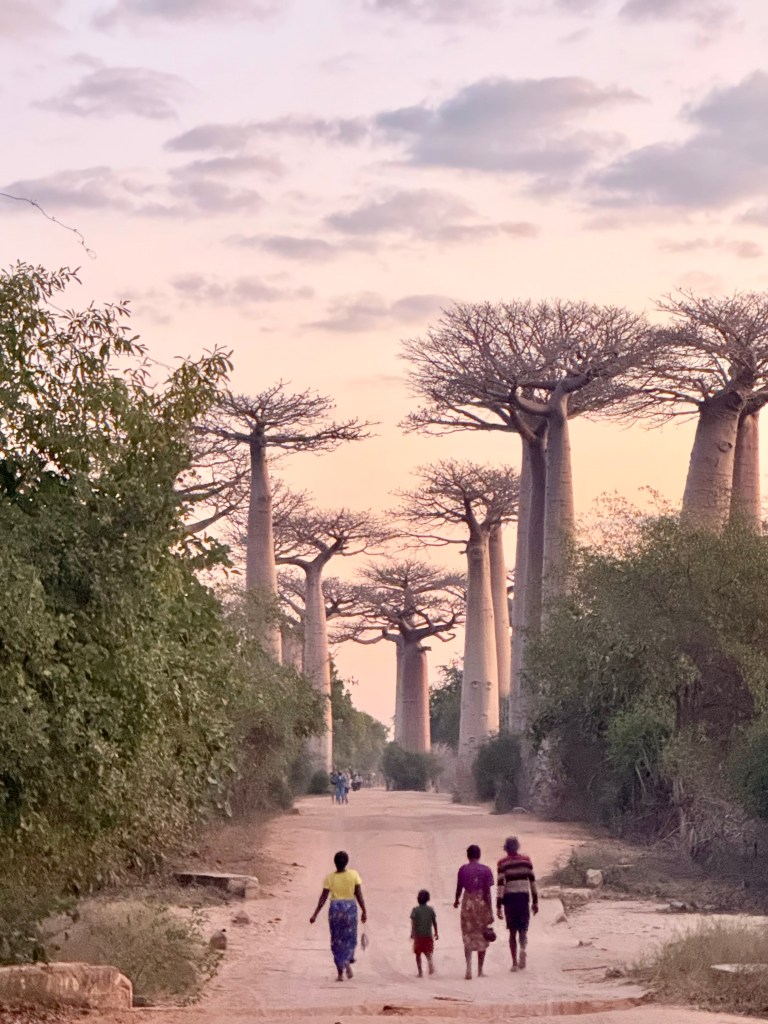
Sunset near Baobab Alley. Not the romanticized version of Madagascar, just the real communities you pass while riding down the road.
Exercise / Outdoors in Madagascar
Madagascar isn’t a gym-and-studio kind of destination — staying active here means getting outside. The big draw is hiking and trekking through the national parks (Isalo’s canyons, the Tsingy de Bemaraha pinnacles, and the rainforests of Ranomafana and Andasibe), almost always with a required local guide. On the coast there’s excellent surfing around Fort Dauphin and the far south, plus swimming, snorkelling and diving off Nosy Be and Île Sainte-Marie. In the highland cities running is possible but tough — Antananarivo sits at altitude with steep hills, heavy traffic and real air pollution, so head out early and stick to quieter, higher streets. In the bigger cities like Antananarivo and Antsirabe you can also find gyms with a day pass for around $2–3, while in smaller towns your options are mostly hiking, walking to explore, and the outdoor spots below.
🥾 Hiking
🧗 Trekking
🤿 Diving
🌿 Rainforest
🏄 Surf
Traveling As A Couple — Exploring the South of Madagascar
My girlfriend and I decided to explore more of the south of Madagascar. We started in Antananarivo and stayed four days — which, honestly, was a couple of days too many. Two days is plenty for the central area: it’s chaotic and crowded, and there are a lot of people asking for money. So we rented a car and pointed it south.
Then the real adventure started.
Driving yourself here is a completely different experience from going with a guide. With a guide everything is stricter and on someone else’s schedule; with your own car you decide where to go, when, and for how long — and I loved that freedom. The catch is the roads: they’re rough, and a short distance on the map can take up to eight hours. Some days I drove from 6am to 7pm just to reach the next stop. It’s genuinely tiring, but watching the landscape transform along the way made every long drive worth it.
Somewhere on the long road south — the scenery kept changing, and that’s what made the drive worth it.
Here’s the honest part: Madagascar isn’t for everyone. It’s a destination for people who go in knowing they’ll be a little uncomfortable — this isn’t a polished, Western-style trip where everything is easy: fast internet, hot showers, and whatever food you’re craving simply aren’t guaranteed. But if none of that scares you, it’s genuinely one of the most fascinating places you can travel. And doing it as a couple makes the rough edges easier — you always have someone to talk to, to plan the next move with, and to laugh about the wrong turns with. Travelling solo here isn’t bad at all, but I think it would feel lonelier than in most other destinations.
The south gave us some of the hardest driving days and the best memories of our travels so far. If you’re coming as a couple, my advice is simple: rent a car if you can, don’t over-schedule, and accept that here the journey really is the trip.
And if you want my more honest, unfiltered thoughts on Madagascar — the staggering beauty alongside the hard realities of moving through one of the poorest countries in the world — I wrote them all down in this separate, more personal piece.
Stay In The Loop
Join 14 Years Of Lessons Learned
Unsubscribe anytime — no spam, just stuff that works.
More Madagascar Guides
Enjoyed this guide? Here’s everything else we’ve written about being a digital nomad in Madagascar — the real WiFi data, where to work and stay, and our honest personal reflections:
Been to Madagascar? Share Your Experience!
About Me

The Creator Of Digital Nomad Lifestyle
Hi! My name is Loren Ross, after establishing my own business while traveling the world I decided to create this blog for existing and aspiring digital nomads.
See My Full Journey To Being A Digital Nomad Here
Anything you want that you’re not seeing? Please reach out to me on one of the social media channels below, I’d love to see if I can help out. Check out my digital marketing business.
searchmarketingconsultingdenver.com
Leave a Comment